
The Ultimate Facebook Engagement Guide
The Facebook Engagement Guide: What Actually Works Now
Originally published January 2019 on vincentgoh.com — rebuilt entirely for 2026 because the platform has changed more in seven years than in the decade before.
In January 2019, the biggest question in Facebook marketing was: “How do we get more engagement?” The answer, backed by data from 777 million posts, was simple: post video, post on Sundays, keep text under 50 characters, and post between 9–11pm EST.
In 2026, that advice will get you somewhere between mediocre results and active suppression by an algorithm that has fundamentally rewritten the rules of how content gets seen. The platform has undergone more structural change since 2019 than it did in the entire decade before it — new AI ranking models, a complete video unification under Reels, a feed that now shows more content from strangers than from people you follow, and the quiet death of the link post as a viable organic strategy.
This is not a refresh of the 2019 guide. It’s a replacement.
First: Understand What Facebook Has Actually Become
Before tactics, you need a clear-eyed picture of the platform you’re operating on, because many businesses are still running 2019 Facebook strategies on a 2026 Facebook machine.
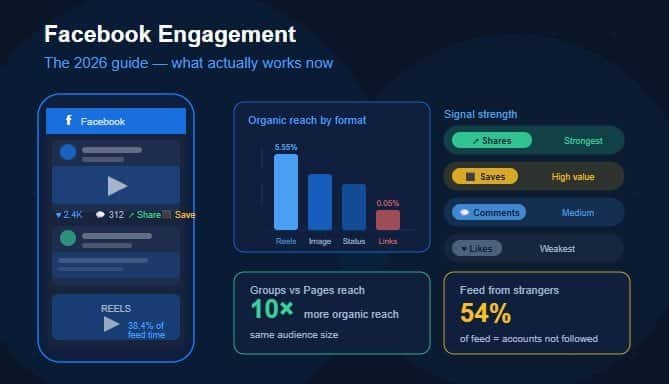
Up to 50% of your Feed now comes from accounts you don’t follow — a figure that has since crept to 54% of the average Facebook user’s feed, with users aged 18–34 showing a 61% receptivity rate to recommended content from unfamiliar accounts. This is the single most important structural shift on the platform: Facebook has moved from a social graph (showing you what your connections post) to an interest graph (showing you what AI predicts you’ll engage with). The implication cuts both ways. Your content can now reach far beyond your follower count if it’s strong — but your follower count no longer protects your distribution if it isn’t.
Average organic reach per post now sits at 1.6–5.9% of Page followers, depending on page size and content type. Large Pages are effectively penalised for their scale — a Page with 100,000 followers can expect approximately 2,200 people to organically see any given post, unless it earns strong early engagement.
All videos are now classified as Reels — Meta made this change in mid-2025 — and Reels now account for 38.4% of all time spent on Facebook globally.
And critically: data shows that between 2018 and 2025, Facebook referrals as a percentage of web traffic to publisher websites dropped more than 75%.98% of posts that users view contain no external link. Facebook is now a closed-loop content ecosystem. It rewards content that keeps people on-platform, and it quietly suppresses content designed to send them away from it.
With that context in place, here is what actually drives Facebook engagement in 2026.
1. Reels Are No Longer Optional — They’re the Reach Engine
In 2019, video was strongly recommended. In 2026, Reels are the primary mechanism by which Facebook distributes content to new audiences. Meta’s October 2025 update confirmed that its refreshed recommendation engine now surfaces around 50% more Reels from creators who published that day — giving fresh video an immediate visibility window that no other format gets.
Creators who posted Reels at a cadence of 4 to 6 times per week experienced a 41% higher follower growth rate compared to those posting fewer than twice weekly. And from a format performance standpoint, Buffer’s analysis of over 52 million posts in 2026 found that video content achieves a median engagement rate of 5.55%, compared to images at 4.55%, text posts at 2.79%, and link posts at 2.34%.
What’s changed from the 2019 “video first” advice: the type of video that works has shifted. Completion rate is now the primary signal — the algorithm prioritises whether users watch the entire video. A 15-second video that most people finish performs far better than a 1-minute video that users quickly swipe past. The 2019 finding that 3–5 minute videos performed best is now obsolete. In 2026, the optimal Reel is under 60 seconds, with the first three seconds doing the work of keeping people watching.
The “First 3 Seconds” Rule: users decide whether to stay in less than 3 seconds. The beginning of the video must get straight to the point or use high-impact visuals to compel the user to keep watching.
2. The Algorithm Now Measures What the 2019 Algorithm Couldn’t
The 2019 guide covered Facebook’s “meaningful interactions” shift — the change Mark Zuckerberg announced in early 2018 that deprioritised passive content in favour of posts that sparked real conversation. In 2026, that philosophy has been encoded into a far more sophisticated AI system.
Meta launched the User True Interest Survey (UTIS) model in January 2026 for Reels recommendations. Instead of relying solely on engagement metrics, Meta now surveys users in-feed asking “How well does this video match your interests?” — A/B testing with 10+ million users showed a +5.4% increase in high survey ratings and a +5.2% boost in total engagement.
Meta’s next-generation AI ranking model, RankNet-7, reduced average user content abandonment rates by 27.4% compared to its 2024 predecessor, while processing behavioural micro-signals such as cursor hover duration, partial scroll depth, and re-read frequency.
What this means practically: the algorithm is no longer just counting interactions. It’s measuring satisfaction. Content that generates passive scrolling is being distinguished from content people actually wanted to see — and the distribution gap between high-relevance and low-relevance content has widened dramatically. Posts falling below a relevance score threshold of 4.2 out of 10 received a median organic reach of only 1.3% of a page’s followers, while posts scoring above 7.8 achieved an average organic reach of 18.6%.
3. Saves and Shares Have Overtaken Likes as the Key Signals
The 2019 guide correctly identified that engagement type mattered, not just volume. In 2026, the hierarchy has become much clearer — and likes have dropped significantly in algorithmic weight.
Saves and shares are the most powerful signals in 2026 — more valuable than likes or reactions.Shares are the currency of organic reach. When someone shares your content — to their timeline, to a group, or via private message — they’re telling Facebook the content is valuable enough to pass along. That signal triggers wider distribution faster than any other engagement type.
Facebook’s 2025–2026 algorithm has elevated “saves” as a quality signal. Posts that users save signal high informational value — creating reference-quality content, such as guides, checklists, and resource lists, that users want to revisit is now a direct reach strategy.
The comment hierarchy has also been refined. Facebook strictly penalises blatant “engagement bait” such as “Like and share this post.” Brands should trigger spontaneous comments through high-quality content — debates, educational carousels, or emotional storytelling — rather than explicit asks.
What this means for your content strategy: design your content backward from the share or save. Ask yourself: would someone send this to a friend? Would someone bookmark this to come back to? If neither, you’re producing content that generates likes — the weakest signal the algorithm tracks.
4. Groups Are the Last Great Organic Reach Opportunity on Facebook
This section didn’t exist in the 2019 guide at all, because Facebook Groups weren’t yet the reach goldmine they’ve become.
Facebook Groups are one of the last organic reach goldmines on social media. With 1.8 billion monthly active Group users, Groups consistently deliver higher organic distribution than Pages. Group posts rank higher in the Feed than Page posts because they signal community engagement.
The contrast in reach is striking. A group with 10,000 members can expect a typical post to reach 2,000–4,000 members — and a high-quality post to reach 5,000+. The same 10,000-person Page audience would see just 200–600 people from the identical post.
If you’re running a business Facebook Page without a companion Group, you’re operating at roughly one-tenth the organic reach you could have. The strategic move in 2026 is to treat your Page as your public storefront and your Group as your primary distribution channel — post natively to the Group, and share to the Page secondarily.
5. Responding Within the First 60 Minutes Is Now a Ranking Signal
The 2019 guide advised responding to comments as a community-building practice. In 2026, early response is an algorithmic input, not just a social nicety.
Posts where creators respond to comments within the first hour receive 2.1x more total engagement, as algorithms reward early interaction signals.Actively responding to every comment within the first 60 minutes of posting creates a “conversation thread” that Facebook’s algorithm recognises as a high-value post. Longer, more detailed replies generate more reply activity than brief acknowledgments.
The practical implication: don’t publish and walk away. Schedule your posts for times when you can actively participate in the first hour of comments. A well-seeded discussion in the first 60 minutes can be the difference between a post reaching 2% of your followers and 15%.
6. Link Posts Are Now the Weakest Organic Format
This is the finding that most contradicts standard marketing advice still circulating online. Link posts continued to generate the lowest engagement rates on Facebook, remaining flat at 0.05% in Q1 2026 — roughly half the engagement generated by most other content formats.
The strategic takeaway for brands is that organic social isn’t meant to function as a free web traffic engine. Every click away from the platform limits engagement time, advertising impressions, and data collection. Facebook’s algorithm has internalised this platform interest — content that keeps users on-site gets rewarded; content that sends them away gets suppressed.
The practical workaround many brands now use: post native content (a video, a carousel, a text post) that delivers the core value of your linked content directly on Facebook, and include the link in the first comment rather than in the post body itself. You get the distribution of a native post; the link is available for those who want it.
7. Content Consistency and Thematic Focus Now Matter More Than Posting Volume
The 2019 advice leaned heavily on identifying the best times and days to post. Current data suggests consistency and thematic coherence matter far more than time-of-day optimisation.
The algorithm scans an account’s last 9 to 12 posts to define its brand “tag.” If content is too scattered — finance, pets, and news posted simultaneously — the AI cannot precisely define the audience, leading to lower recommendation weight. Focus on 2 core themes to build stable account authority.
On frequency: data from 2026 shows the optimal posting frequency is 5–7 posts per week, with diminishing returns above 10 posts per week and significant engagement drops below 3 posts per week. Consistency matters more than volume — algorithms reward regular posting schedules that signal reliability. For Reels specifically, the target is 2–4 per week.
Meta deployed its Content Authenticity Engine (CAE) across all Facebook surfaces, scanning over 900 million posts per day for duplication and low-effort republishing, resulting in a 63% reduction in recycled content appearing in users’ top 10 feed positions. Reposting content from TikTok or Instagram — with the competing platform’s watermark intact — is one of the most reliable ways to tank your distribution in 2026.
8. The 2026 Facebook Engagement Hierarchy (What to Optimise For, in Order)
Distilling everything above into a clear priority stack:
- Reels first — the only format that receives active algorithmic push to non-followers. 4–6 per week if possible, 2 at minimum.
- Shares and saves — design content backward from the question “would someone send this to a friend or bookmark it?”
- Early comments — reply within 60 minutes of posting to trigger the conversation-thread boost.
- Groups over Pages — 10× the organic reach for equivalent audience sizes.
- On-platform content — keep your most valuable content native; save links for the comments.
- Thematic consistency — two core content themes per account, not five.
- Quality over quantity — 3–5 high-quality posts per week outperforms daily low-effort publishing.
What Didn’t Change
It’s worth acknowledging what the 2019 guide got right that still holds.
The New York Times’ five reasons people share content online — to delight others, to identify themselves, to foster relationships, for self-fulfilment, and to raise awareness — remain accurate and useful. People haven’t changed; only the mechanics of how the platform surfaces content to them have.
73% of social users say they’ll buy from a competitor if a brand doesn’t respond to them on social, and nearly three-quarters expect a response within 24 hours. Response time as a commercial signal is not new — it’s just now embedded in the algorithm as well as in customer expectations.
And “edutain” — Mari Smith’s word for content that teaches something in an entertaining way — remains exactly the right north star. It just needs to do it in 15–60 seconds, start with a compelling hook, and be designed to be saved or shared rather than merely liked.
Want help auditing your Facebook strategy against the 2026 algorithm? Get in touch.