
The Complete Guide to YouTube Advertising
The Complete Guide to YouTube Advertising
Here are the three facts that define YouTube advertising today, before we get into formats or tactics:
First, YouTube’s 2025 ad revenue of $40.4 billion exceeded the combined advertising haul of Disney, NBCUniversal, Paramount, and Warner Bros. Discovery — the most significant shift in where TV advertising dollars flow since television was invented. This is no longer a “digital marketing channel.” It is the dominant video advertising medium, full stop.
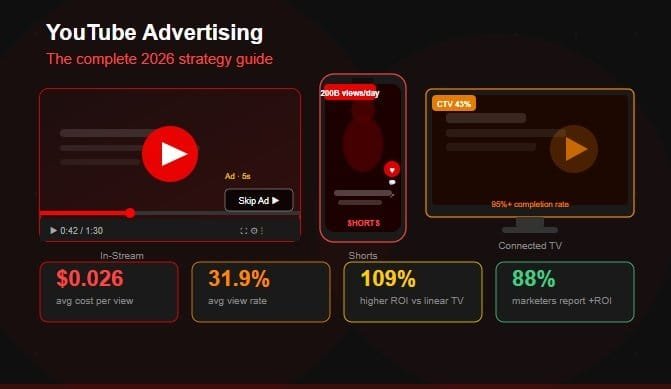
Second, in Q1 2025, YouTube ad spend on TV screens (Connected TV) surpassed mobile placements for the first time — 43% to 42% — nearly doubling the CTV share from just a year earlier when it was 24%. If you’re still planning YouTube campaigns purely as a mobile and desktop channel, you’re misallocating a significant portion of your budget.
Third, YouTube Shorts now generates 200 billion daily views, up from 70 billion in early 2024. The short-form surface that barely existed in the original guide is now one of the fastest-growing ad formats in digital marketing, with its own creative requirements, bidding mechanics, and audience psychology that differ fundamentally from standard YouTube campaigns.
This guide covers all of it — current formats, real benchmarks, the AI campaign types that have replaced legacy structures, and the mistakes that are costing most advertisers budget right now.
The Platform in 2026: Scale, Reach, and Where the Audience Actually Is
Before you write a single line of ad copy, understand the environment you’re operating in.
YouTube’s monthly active user base reached approximately 2.70 billion people in early 2025 — over 25% of the world’s total population, and roughly half of all internet users. YouTube ads reach 2.53 billion users globally, representing 45.5% of all internet users.
The demographic makeup matters for targeting. The largest YouTube advertising audience segment is 25–34 year-olds at 21.7%, and in the U.S., 84% of people aged 12 and over use YouTube monthly. This is not a young-skewing niche platform — it is a mass-reach medium with exceptional targeting precision layered on top.
Users spend an average of 48.7 minutes daily on YouTube in 2026. That is more than Netflix, more than TikTok, and more than any linear television network draws from any single demographic. YouTube holds 12.5% of all U.S. TV viewing time — the #1 streaming service on American television for four consecutive months as of May 2025, ahead of Netflix, Hulu, and every other individual service.
The strategic implication: YouTube delivers 109% higher ROI than linear TV and 23% higher ROI than other social media channels, and 88% of marketers report positive ROI from YouTube advertising.
The Ad Formats That Actually Matter in 2026
The original guide covered five formats. In 2026, the format landscape has both consolidated and expanded — two legacy campaign types have been replaced by AI-powered structures, while Shorts and Connected TV have emerged as genuinely new surfaces requiring purpose-built creative.
Skippable In-Stream Ads
Skippable in-stream remains the most versatile YouTube ad format in 2026 for most advertisers. The mechanics are unchanged from 2019: viewers can skip after five seconds, and you only pay when someone watches at least 30 seconds or the full ad if it’s shorter, or clicks. What has changed is the competitive environment and the creative stakes.
The first five seconds determine campaign ROI: viewers decide to skip or watch within the first five seconds of a skippable ad. Ads that establish brand presence before the skip button appears see 40% higher view-through rates than ads that bury branding at the end.
The average cost-per-view sits at approximately $0.026, with a 31.9% view rate — meaning nearly one in three people exposed to a YouTube ad choose to watch past the skip threshold. For context, a 0.1% CTR is considered strong in display advertising. YouTube’s engagement baseline is structurally different.
Non-Skippable In-Stream and Bumper Ads
Non-skippable in-stream ads (up to 15–20 seconds) and bumper ads (6 seconds, non-skippable, CPM-bought) remain unchanged in mechanics. 6-second bumper ads drive top-of-funnel awareness at scale; 15-second non-skippable ads suit brand moments requiring guaranteed full-message delivery.
The 2026 warning: bumper ads and non-skippable ads guarantee exposure but carry the highest frequency fatigue risk and require strict caps. For bumper ads, cap at three impressions per user per week; for non-skippable 15-second ads, set two to three per week. More than that and your campaign actively damages brand perception.
YouTube Shorts Ads — The Biggest New Surface
This format didn’t exist in the original guide. It is now one of the most important decisions you make in a YouTube media plan.
YouTube Shorts now accounts for 22% of the platform’s total ad revenue, up from 15% in 2024, and Shorts went from a product experiment to an $8.9 billion revenue line in two years.
Shorts ads run natively at 9:16 aspect ratio between organic Shorts in the vertical feed, with no skip option, and require vertical-first creative to perform. Native-feeling creative outperforms repurposed landscape content by up to 3× on completion rates.
The viewer psychology is different from standard YouTube, and this matters enormously for creative. Shorts viewers are in a rapid-consumption, swipe-or-stay mode — they make viewing decisions in under two seconds versus five seconds for standard in-stream ads. Creative that opens with a slow introduction, a title card, or a brand logo will be mentally dismissed immediately even though it cannot be skipped.
On cost: average Shorts ad costs currently run $0.10–$0.30 CPV, often with superior view-through rates compared to standard placements. Strike Social data shows that Video View Campaigns including Shorts placements deliver up to 56% cost savings compared to traditional YouTube TrueView.
Budget at least 20–30% of your YouTube spend toward Shorts if your audience skews under 35.
Connected TV Ads — The Channel Reshaping Everything
Connected TV ad formats now contribute 34% of YouTube’s total ad revenue as brands shift significant portions of their broadcast budgets to YouTube’s living-room viewing environment. 150 million Americans watch YouTube on their television screens every month.
CTV placements require a completely different creative approach. CTV viewers watch on large screens in lean-back mode with minimal distraction. CTV completion rates average 95% or higher versus 30–40% on mobile. This means your CTV creative needs to be higher production quality, longer (30–60 seconds), and built for passive, immersive viewing — not the scroll-stopping vertical hook style that works on Shorts.
YouTube TV now has 12 million U.S. subscribers and surpassed Hulu + Live TV to become the largest virtual multichannel video programming distributor in the country. For brands that previously ran Super Bowl-style awareness campaigns on broadcast TV, YouTube CTV is now the more measurable, better-targeted, and often more cost-efficient equivalent.
In-Feed Video Ads
Previously called Video Discovery Ads, these appear in YouTube search results and alongside related videos. For consideration-stage campaigns, especially in B2B, in-feed video often delivers the lowest cost per engaged viewer because users actively choose to watch. The user intent signal is stronger than in-stream — someone who clicks a thumbnail in search results is expressing active interest, not being interrupted.
The Campaign Types That Replaced What You Used to Use
This is the section most outdated guides ignore. If you’re still talking about TrueView for Action or Video Action Campaigns as standalone campaign types, you’re using a 2023 playbook.
Demand Gen (Replaced Video Action Campaigns)
As of Q2 2025, the full transition from Video Action Campaigns to Demand Gen is complete, with early adopters seeing up to 40% lower CPC. Demand Gen campaigns now serve ads across YouTube (in-feed, Shorts, in-stream), Gmail, and Discover from a single campaign.
The power is in the reach consolidation. The risk: when you run standalone YouTube campaigns alongside Demand Gen campaigns that also serve on YouTube, you can hit the same user far more often than intended. Google does not automatically deduplicate frequency across these campaign types. Cross-campaign frequency overlap is one of the most common and costly mistakes in YouTube advertising right now.
Video View Campaigns (VVC)
Video View Campaigns include in-stream skippable ads, in-feed ads, and YouTube Shorts feed placements. Since their launch in Q3 2023, VVC has shown significant cost efficiency, with campaigns demonstrating up to 56% savings over traditional TrueView.
Performance Max with Video
Performance Max campaigns automatically serve across all of Google’s inventory, including YouTube Shorts. For e-commerce brands running Performance Max, Shorts placements are already being served. If your PMax creative assets do not include vertical video, you are leaving YouTube Shorts inventory on the table.
Targeting in 2026: First-Party Data Has Become the Foundation
The original guide’s targeting section covered demographics, interests, keywords, and remarketing — all of which still apply. What has changed is the underlying data environment that powers them.
Privacy changes, particularly Google’s Consent Mode overhaul, have reduced the size and accuracy of third-party audiences and remarketing lists in many markets. First-party data and Customer Match lists are more important than ever for YouTube targeting.
Customer Match — uploading your own email or phone number lists to build YouTube audiences — now functions as the foundation of effective YouTube targeting for businesses with any kind of customer database. Build your Customer Match lists first, then expand to Similar Audiences and interest-based segments from there.
Intent-based targeting still produces exceptional results when the signal is strong. Intent-targeted YouTube ads produce 100% higher lift in purchase intent versus demographic-only targeting.
Creative Strategy: The Rules That Are New in 2026
The five-second rule for in-stream. Viewers decide to skip or watch within the first five seconds. Lead with your brand, a striking visual hook, or a problem statement. Don’t save your best moment for the end — no one sees it.
The two-second rule for Shorts. For Shorts, the effective engagement window is 0–2 seconds: a surprising image, fast-cut sequence, or compelling visual change must appear immediately. Shorts audiences have different expectations, and creative that feels like an ad gets swiped past instantly.
Never repurpose across aspect ratios without re-editing. Repurposing your 30-second horizontal in-stream ad by simply cropping it for Shorts does not work. Build a Shorts-native version, or don’t run Shorts.
Sound-off optimisation for Shorts and CTV. The majority of Shorts content is consumed without sound, and CTV often plays in rooms where audio competes with conversation. Text overlays are not optional on vertical formats — they are how your message reaches viewers who can’t or won’t listen.
Frequency management across campaign types. YouTube advertising in 2026 rewards advertisers who manage frequency aggressively. The penalty for getting this wrong is not just wasted budget — it is audience fatigue that makes future campaigns harder and more expensive.
Benchmarks: What You Should Actually Expect
Average CPV: $0.026 | Average CPM: $3.50 | Average CPC: $0.49 | Average ad CTR: 0.65% | Average view rate: 31.9%
Shorts CPM runs lower — approximately $4 CPM, one of the most affordable video ad formats in digital marketing.
CPM dispersion across industries is wider on YouTube than on any other social platform — a financial-services CPM is 50% above an entertainment CPM, driven by competitive bidding pressure from regulated industries with high lifetime value.
One critical warning on measurement: the default attribution window in Google Ads is often too generous, inflating YouTube’s apparent contribution. Shorten your view-through conversion window to three days or less and compare results against a holdout group when possible. Treat view-through conversions as a supporting data point alongside assisted conversions in GA4 and direct response metrics.
The 2026 YouTube Advertising Checklist
Before launching any YouTube campaign in 2026, run through these:
Campaign structure:
- Have you uploaded Customer Match lists as your targeting foundation?
- Are your Demand Gen and standalone YouTube campaigns frequency-capped and deduplicated?
- Does your Performance Max campaign include vertical 9:16 creative for Shorts inventory?
Creative by format:
- In-stream: Does your ad establish brand presence in the first five seconds?
- Shorts: Does your ad hook in under two seconds? Is it purpose-built vertical, not a cropped horizontal?
- CTV: Is your creative 30–60 seconds, higher production quality, optimised for a large lean-back screen?
Measurement:
- Have you shortened your view-through conversion window to three days or less?
- Are you tracking assisted conversions in GA4, not just platform-reported ROAS?
- If you’re running CTV, have you set up incrementality testing to measure true lift?
Budget allocation:
- Are you allocating 20–30% of YouTube budget to Shorts if your audience skews under 35?
- Are you accounting for CTV’s higher CPMs but stronger completion rates in your planning?
YouTube is no longer a supplementary channel to test with leftover budget. 71% of video advertisers now put 30% or more of their video budgets exclusively on YouTube. The platform has earned that allocation — but only if you’re running 2026 campaigns with 2026 creative and 2026 campaign types. Running 2019 strategies on a 2026 platform is the most reliable way to produce 2019 results.
Need help building a YouTube advertising strategy for your business? Get in touch.